




Structuring An Effective Mentorship Program: 6-Steps to Success
 Omer Usanmaz
·
16 minute read
Omer Usanmaz
·
16 minute read
Updated for 2026
A well-structured mentoring program enables meaningful knowledge exchange, strengthens employee engagement, and develops resilient leadership pipelines. It supports personal and professional advancement across all levels of an organization. Whether you are launching a new mentorship program or refining a corporate mentorship program, this guide outlines essential steps to build, manage, and scale effective mentoring programs. With Qooper, organizations can streamline mentor matching process, track progress, and ensure measurable impact at every stage of a mentor-mentee program
Whether you’re creating a mentorship program from scratch or improving an existing internal mentoring program, having a clear mentorship plan and defined program objectives is essential. From corporate mentoring programs to youth and community mentoring programs, effective mentoring strategies share one goal-building meaningful mentor-mentee connections that drive growth.
|
20% higher retention in organizations using mentoring software |
2x faster leadership readiness with structured mentoring |
49% lower attrition among program participants |
50% faster time to productivity for mentored new hires |
What Is a Mentorship Program?
So, what is a mentorship program? The answer is simple: A mentoring program is a structured initiative within an organization designed to facilitate professional growth, skill development, and career advancement through mentor-mentee relationships.
Workplace mentoring programs are powerful for promoting employee growth and development while building a positive workplace culture.
Accessibility to mentorship allow employees to learn from seasoned professionals, prepare for leadership positions, and gain relevant skills. Students, early-career employees, and engineers alike benefit from mentoring tracks tailored to specific professional development goals.
For formal mentoring programs, it’s crucial to establish clear guidelines, identify mentors, and provide comprehensive training mentors initiatives. Using an employee mentoring program template or a mentorship plan template can guide organizations in creating a mentorship curriculum aligned with organizational objectives, ensuring effective mentoring programs that promote long-term growth.
Key factors in building a high-impact mentorship plan include participant experience level, technical skills, location, professional networks, and the competencies to be learned. Mentoring cycles need regular check-ins, feedback sessions, and development opportunities. These are essential for sustained effectiveness.
Why Start a Mentoring Program?
Mentorship programs are a proven strategy for organizational growth and talent development. Here's why companies invest in effective mentoring programs:
- Improve Employee Retention: Employees engaged in mentorship programs at work are more likely to stay. Programs improve job satisfaction, connection, and purpose.
- Accelerate Career Development: Employees gain insights and advice aligned with their career goals, increasing the pace of professional growth and internal mobility.
- Boost Employee Engagement: Structured mentor programs in the workplace create a culture of continuous learning, collaboration, and community.
- Build Leadership Skills: Mentorship and guidance enhance soft skills and leadership capabilities across all levels through Leadership Development Mentoring Programs and High Potential Mentoring Programs.
- Encourage Knowledge Sharing: Through reverse mentoring, peer mentoring, and mentoring circles, organizations foster cross-functional, cross-generational knowledge transfer.
Stat: Organizations using mentoring software like Qooper see up to 20% higher retention and 2x faster leadership readiness.
👉 Worth Checking: How to Start a Mentorship Program
Types of Mentorship Programs
Mentoring programs can take many forms depending on organizational needs. Common types include:
|
Program Type |
Best For |
Key Outcome |
|
Corporate mentorship |
Leadership & talent retention |
Succession planning, promotion rates |
|
Peer-to-peer mentoring |
Same-level knowledge exchange |
Cross-functional collaboration |
|
Youth & student mentoring |
Career exploration |
Job placement, alumni engagement |
|
Reverse mentoring |
Technology & DEI upskilling for seniors |
Innovation, inclusivity |
|
Diversity mentoring |
Underrepresented group advancement |
Equitable opportunity, representation |
|
HR onboarding mentoring |
New hire integration |
Reduced ramp time, retention |
|
Future leader acceleration |
Leadership pipeline, succession |
|
|
Peer mentorship (ERG) |
Community & belonging |
Culture, ERG engagement |
- Corporate mentorship programs to develop leadership and retain top talent.
- Peer-to-peer mentoring programs that encourage knowledge exchange among employees at similar levels.
- Youth mentoring programs that support students and young adults in career exploration.
- HR mentoring programs designed to align employees with company culture and values.
- Professional mentorship programs that pair early-career professionals with experienced mentors.
- Diversity mentoring programs to strengthen inclusion and equitable opportunities.
Choosing the right type helps ensure your mentorship program aligns with company goals and participant expectations. If you’re wondering how to start a mentoring program, begin by defining its purpose and desired outcomes. Create a mentorship program proposal or business plan that outlines your objectives, resources, and success metrics. Identify program sponsors. Design your mentorship curriculum. Establish clear mentorship guidelines templates to ensure consistency.
Download 6-Month Company-Wide Career Mentoring Steps
What Makes an Effective Mentorship Program?
An effective mentoring program delivers value to both mentors and mentees while aligning with broader organizational goals. Successful programs:
|
Characteristics |
Description |
|
Clear objectives |
Program goals are defined upfront and tied to specific business outcomes (retention, leadership, DEI) |
|
Structured guidelines |
Both mentors and mentees have defined roles, expectations, and session frameworks |
|
Measurable KPIs |
Success is tracked through engagement metrics, promotion rates, retention, and satisfaction scores |
|
Quality matching |
Compatibility goes beyond job title — AI-powered matching considers goals, communication style, and aspirations |
|
Leadership support |
Senior sponsorship ensures resources, visibility, and organizational credibility for the program |
|
Diverse formats |
Supports virtual, hybrid, group, reverse, and peer mentoring — not just one-on-one in-person sessions |
|
Ongoing iteration |
Quarterly reviews, participant feedback, and data-driven refinements keep the program improving |
Unsuccessful programs often:
- Lack defined goals and metrics
- Provide poor participant matching
- Are unsupported by leadership or software
- Do not accommodate diverse mentoring experiences (e.g., virtual mentorship, group mentoring)
What Are the 4 C's of Mentorship?
The foundational 4 C's of mentorship are Communication, Connection, Clarity, and Commitment. These core principles underpin every successful mentor program and serve as the framework for growth, learning, and development.
Communication
Open, honest, and ongoing communication is the cornerstone of effective mentorship programs. It ensures expectations are aligned, feedback is constructive, and progress is regularly discussed. Mentors and mentees who maintain strong communication habits are more likely to build trust and achieve set goals.
Connection
Mentorship thrives on genuine human connection. Mentors and mentees must take time to understand each other's backgrounds, values, and aspirations. This bond fosters psychological safety, empathy, and a shared purpose that goes beyond transactional knowledge sharing.
Clarity
Clear objectives, roles, and timelines help define the mentoring journey. Both parties should know what they want to achieve and how success will be measured. Clarity eliminates confusion and keeps the relationship purposeful and focused.
Commitment
Commitment reflects dedication to the process. It requires showing up consistently, preparing for sessions, and investing time in the relationship. When mentors and mentees commit fully, the mentoring program becomes a catalyst for real transformation.
Mentoring Goals: What to Set and How to Track Them
One of the most common reasons mentoring programs underperform is a failure to set clear, measurable goals at the start. Effective mentoring goals give both mentor and mentee a shared destination — and give program administrators data to demonstrate ROI.
Types of Mentoring Goals
-
Career development goals — targeting a specific promotion, role transition, or salary milestone within a defined timeframe
-
Skill development goals — closing a specific technical or soft skill gap identified through performance reviews or self-assessment
-
Leadership readiness goals — building the competencies required for a managerial or executive role
-
Network expansion goals — making a defined number of strategic connections within or outside the organization
-
Knowledge transfer goals — capturing institutional knowledge from a senior employee before a transition or retirement
-
DEI advancement goals — supporting underrepresented employees in navigating career barriers and accessing sponsorship
How to Write SMART Mentoring Goals
Mentoring goals should follow the SMART framework — Specific, Measurable, Achievable, Relevant, and Time-bound. Vague goals like 'improve my leadership skills' produce vague outcomes. Effective goals sound like:
- 'Complete two stretch assignments in cross-functional projects by Q3 to build leadership experience'
- 'Earn AWS Solutions Architect certification within 6 months with weekly mentor-guided study sessions'
- 'Move from individual contributor to team lead role within 12 months, with monthly coaching from a senior manager'
Tracking Goals Inside Mentoring Software
The best mentoring programs don't track goals on sticky notes or spreadsheets. Mentoring platforms like Qooper include built-in goal-setting modules where mentees log objectives, track milestones, and record progress after each session. Program administrators can view aggregate goal completion rates across the entire program — a key input for ROI reporting.
Goal-setting insight
Programs that set structured goals in the first mentoring session report 3x higher session completion rates and significantly stronger outcome data at the end of the program cycle.
Download Mentorship Goal Setting Template
How to Build an Effective Mentoring Program
Once your program is strategically structured, focus shifts to implementation and ongoing management to ensure success. Start by selecting a robust mentoring platform like Qooper, which automates key administrative tasks, from enrollment and matching to feedback collection and reporting.
Next, launch targeted recruitment efforts to attract and engage mentors and mentees, leveraging internal communications and leadership support to build enthusiasm. Provide comprehensive mentorship training programs for participants to align expectations and equip both mentors and mentees with best practices for effective mentoring strategies.
Throughout the program lifecycle, maintain active communication to encourage consistent engagement and address challenges proactively. Use dashboards and analytics to monitor key metrics such as meeting frequency, goal progress, and participant satisfaction. Based on these insights, make timely adjustments to improve the experience. Finally, celebrate milestones and share success stories to reinforce the program's value and sustain momentum.
How to Structure a Mentorship Program in 6 Steps
Creating a mentorship program that is both sustainable and scalable starts with a solid strategic framework. Begin by clearly defining the program's objectives and aligning them with broader organizational goals such as leadership development, onboarding, succession planning, or employee retention. Choose the mentoring format that best fits your audience and goals. While one-on-one mentoring remains popular for its personalized approach, formats like group mentoring, peer mentoring, reverse mentoring, and mentoring circles can provide added value by fostering diverse perspectives and knowledge sharing.
You can check out the different types of mentoring here!
Once your program's purpose and format are defined, establish foundational elements such as clearly outlining roles and expectations for mentors and mentees, deciding on the duration and cadence of interactions, and developing a structured matching process. Leveraging a data-driven matching algorithm, like the one used by Qooper, significantly improves compatibility and satisfaction for both parties. Provide supporting materials including discussion guides, mentorship agreements, and tools for tracking progress to maintain clarity throughout the relationship. Regularly evaluate participation, satisfaction, and impact to enable continuous refinement.
Step 1: Define Objectives and Success Metrics
What problem are you trying to solve?
Identify whether your goal is to improve retention, accelerate onboarding, prepare future leaders, or build cross-functional collaboration.
How will you measure success?
- Define KPIs (e.g., retention rates, engagement scores, promotion rates).
- Consider both short-term outputs (e.g., participation rates) and long-term outcomes (e.g., career development).
Are these objectives aligned with business goals?
Ensure the program supports broader company strategies such as DEI, leadership pipelines, or talent development.
Step 2: Choose Your Mentorship Format
Which format best supports your goals and audience?
Will your format support remote and hybrid teams?
|
Format |
Structure |
Best For |
|
1:1 mentoring |
One mentor, one mentee, regular sessions |
Career development, leadership coaching, onboarding |
|
One mentor, multiple mentees |
Knowledge sharing, cohort programs, ERGs |
|
|
Same-level pairs or small groups |
Cross-functional learning, early-career employees |
|
|
Junior mentors senior on specific topic |
Technology adoption, DEI awareness, Gen Z insights |
|
|
Single session or short-term (1-3 sessions) |
Networking, targeted advice, alumni connections |
|
|
Small group (4-8) with a senior facilitator |
Leadership development, community building |
|
|
Fully remote via video, chat, and async tools |
Distributed teams, global programs, hybrid workplaces |
Will your format support remote and hybrid teams? Decide on in-person, virtual, or blended formats based on your workforce setup. Most enterprise programs in 2026 default to virtual or hybrid delivery, requiring mentoring software with native video integration, async messaging, and mobile access.
Step 3: Recruit and Attract Participants
How will you raise awareness?
-
Leverage internal newsletters, all-hands presentations, and leadership endorsements to explain the program's value
- Build a program landing page with clear enrollment steps — mentoring software like Qooper provides ready-made enrollment pages
- Use HRIS integrations to surface eligible participants and send targeted invitations based on role, tenure, or performance tier
What's in it for them?
- Clearly communicate personal and professional benefits for both mentors (leadership practice, recognition) and mentees (career guidance, visibility)
- Address 'what success looks like' with concrete examples — testimonials, promotion stories, and case studies from previous cohorts
How do you ensure inclusivity?
- Create open application processes and avoid nomination-only models that replicate existing hierarchies
- Offer orientation and training so employees at all levels feel confident participating — not just high performers
- Track enrollment demographics and adjust outreach if participation skews non-representative
Step 4: Match Mentors and Mentees
Mentor-mentee matching is the single most important driver of program quality. Poor matching leads to disengagement, unfinished sessions, and negative program perception. Strong matching produces lasting relationships and measurable career outcomes.
What factors will you use for matching?
- Career goals and development areas — the primary compatibility dimension
- Communication style and meeting preferences — async vs. synchronous, formal vs. conversational
- Seniority, department, and functional expertise
- Location and time zone alignment for synchronous programs
- Diversity considerations — intentionally cross-functional, cross-cultural, or cross-generational matching where relevant
Manual vs. automated matching?
Manual matching works for small pilot programs (under 30 pairs) but becomes error-prone and time-consuming at scale. AI-powered mentor matching software — like Qooper's algorithm — analyzes 20+ compatibility dimensions simultaneously, improves over time as it learns from engagement data, and produces match quality that consistently outperforms human-curated lists.
Participant input and preferences
Enable participants to share preferences, answer compatibility questions, and indicate any veto constraints before the algorithm runs. Programs that incorporate participant voice into matching report higher engagement than those with fully admin-driven assignment.
Matching best practice
Run a compatibility survey before matching — not after. Understanding each participant's mentoring style, availability, and top goals before the algorithm runs significantly improves first-match quality and reduces rematch requests
Step 5: Enable and Guide Mentoring Relationships
How will you support relationship development?
- Provide goal-setting templates, session agenda guides, and mentoring agreement templates at program launch
- Offer a structured first-session guide — the opening conversation sets the tone for the entire relationship
- Create a resource library of discussion prompts, reading lists, and development frameworks accessible inside the platform
How do you prepare mentors and mentees?
- Host a kickoff orientation webinar covering expectations, platform navigation, and communication best practices
- Train mentors to ask open-ended questions, practice active listening, and give actionable feedback
- Brief mentees on how to lead sessions, set agendas, and take ownership of their own development
How often should they meet?
Most programs recommend bi-weekly or monthly sessions of 45-60 minutes. Shorter, more frequent sessions (30 minutes bi-weekly) work well for busy senior mentors. Build flexibility into the cadence — rigid schedules create dropout risk, while zero structure creates drift. Mentoring software with integrated scheduling and automated reminders maintains cadence without manual coordination.
Step 6: Measure Success and Continuously Improve
Measurement is what transforms a mentoring program from a wellbeing initiative into a strategic talent investment. Without data, you cannot defend budget, demonstrate ROI, or improve program quality over time.
What data will you collect and analyze?
- Participant surveys on satisfaction, perceived value, and relationship quality — collected at 30, 60, and 90 days
- Engagement metrics — session frequency, message activity, goal updates, resource usage
- Career mobility outcomes — promotions, role changes, and internal transfers among program participants vs. a control group
- Retention data — 12-month retention rates for mentored employees vs. the broader employee population
- NPS (Net Promoter Score) — would participants recommend the program to a colleague?
How will you act on feedback?
- Adjust matching criteria based on early-cohort satisfaction data
- Refine session resources and content based on what participants say they need more of
- Recognize and celebrate high-performing mentor-mentee pairs — social proof drives the next cohort's enrollment
How often will you evaluate and iterate?
Quarterly or bi-annual reviews help ensure the program stays aligned with business needs. Use program analytics dashboards — available in mentoring software platforms like Qooper — to monitor KPIs in real time rather than waiting for end-of-cycle reports.
Mentorship Program Template: What to Include
A mentorship program template gives your initiative a replicable, scalable structure. Use the following framework as a starting point and customize it to your organization's goals, culture, and program type.
|
Template Component |
What to Define |
|
Program Name & Goal |
One-sentence description of the program's primary objective |
|
Target Participants |
Who is eligible to be a mentor? Who can apply as a mentee? Inclusion criteria. |
|
Program Duration |
Total length (3, 6, or 12 months) and session cadence (bi-weekly, monthly) |
|
The dimensions used to pair mentors and mentees (goals, skills, style, seniority) |
|
|
Session Structure |
Expected session length, agenda format, and documentation requirements |
|
Goal Framework |
How goals are set, tracked, and reviewed throughout the program cycle |
|
Communication Tools |
Platform, messaging preferences, and escalation path for relationship issues |
|
Training Requirements |
Mentor orientation, mentee onboarding, and any role-specific training modules |
|
Success Metrics |
KPIs, survey cadence, data collection method, and reporting format |
|
Recognition & Completion |
How participants are recognized upon program completion |
Mentorship Program Best Practices for 2026
Based on the most effective corporate mentoring programs, here are the best practices that separate high-impact programs from those that fade after the first cohort.
1. Secure executive sponsorship before launch
Programs with a named executive sponsor receive more resources, greater internal visibility, and higher enrollment rates. The sponsor does not need to run the program — they need to endorse it publicly and remove organizational barriers.
2. Use AI-powered matching, not spreadsheets
Manual matching cannot scale and introduces bias through familiarity and proximity effects. AI mentor matching feature analyzes compatibility across 20+ dimensions simultaneously, improves with each program cycle, and produces demonstrably better outcomes than human-curated matches.
3. Train mentors — do not assume they know how
Being a high performer does not make someone an effective mentor. Provide a 60-90 minute orientation covering active listening, goal-setting techniques, how to give constructive feedback, and how to handle common relationship challenges. Mentors who feel prepared engage more consistently and produce better mentee outcomes.
4. Build accountability into the program structure
Voluntary mentoring relationships without structure drift within 60 days. Accountability mechanisms include: session completion tracking visible to the program admin, automated nudges when pairs go inactive, required goal updates at program milestones, and mid-program check-in surveys that prompt reflection and re-engagement.
5. Measure and communicate impact continuously
Do not wait until the end of the program to collect data. Run pulse surveys at 30, 60, and 90 days. Share participation dashboards with HR leadership monthly. Publish one or two participant success stories per cohort. Continuous visibility keeps the program top of mind and builds the organizational case for expansion.
6. Iterate every cohort
The best mentoring programs treat each cohort as a product release — with retrospectives, data analysis, and deliberate improvements before the next cycle begins. Common iteration points include: refining matching criteria, updating session templates, adjusting the mentor-to-mentee ratio, and improving onboarding materials based on first-session feedback.
Sample Mentoring Program Tracks with Qooper
Mentorship can take many forms, from formal mentoring programs with defined structures to more flexible, informal relationships. Successful formal mentorship programs usually include a clear mentorship plan template. They also provide mentor development resources. Consistent meeting agendas help maintain accountability.
- Leadership Development Mentoring Programs help future leaders build confidence, decision-making skills, and executive presence. These tracks are ideal for succession planning and preparing high-potential employees for managerial roles.
- Functional Skills Mentoring Programs focus on upskilling in areas like marketing, engineering, or operations. By pairing junior employees with experienced professionals, these programs foster peer learning and cross-functional excellence.
- High-Potential Mentoring Programs accelerate the growth of employees identified as future leaders. These tracks are often tied to performance reviews and strategic talent development efforts.
- Employee Onboarding Mentoring Programs support new hires as they transition into the company. By pairing them with seasoned mentors, these programs help improve retention and reduce time to productivity.
- Reverse Mentorship Initiatives encourage senior leaders to learn from younger employees, typically around technology trends, diversity, and social issues, enhancing inclusivity and innovation.
- Volunteer Matching and ERG Mentoring Programs promote community engagement and strengthen organizational culture by connecting employees with shared values or identities.
- Youth Mentoring and Volunteer Programs: Connect students and volunteers to real-life projects, scholarships, or programs like ACE Mentor Program and Global Mentorship Initiative.
- Women’s Mentoring Programs: Empower women in leadership roles through tailored guidance and peer connections.
- Community Mentoring Programs: Strengthen local impact through volunteer-based initiatives.
- Mentoring for New Employees: Help new hires onboard smoothly with structured mentor support.
Additional initiatives include online forums, discussion boards, and podcast series such as College and Family Engagement or ASIS to share insights and track progress. For podcasting series, tools like Riverside podcasting can help manage content production.
Mentoring Software to Scale Your Program
Manual mentorship administration can quickly become overwhelming as programs grow — especially across departments, geographies, and employee populations. That's where enterprise mentoring software like Qooper steps in to streamline the entire lifecycle, from launch to measurable outcomes.
With Qooper, HR and talent teams can automate onboarding, deliver structured mentorship training, and manage multiple program types — from 1:1 career mentoring and leadership development to onboarding, reverse mentoring, and peer learning circles — all from a single admin interface.
Qooper's AI-powered matching engine goes beyond basic profile matching by considering career goals, skill gaps, working styles, availability, and program objectives — creating mentor-mentee pairings that are more likely to drive meaningful development and reduce culture risk.
After the match, structured workflows, meeting agendas, feedback templates, and goal tracking tools keep relationships active and participants engaged throughout the full mentoring journey — so mentors and mentees always know what to do before, during, and after each session.
Real-time reporting dashboards give HR, L&D, and leadership teams visibility into participation, engagement, relationship progress, skill development, and ROI — connecting mentoring activity to business outcomes like retention improvement, faster onboarding, and succession readiness.
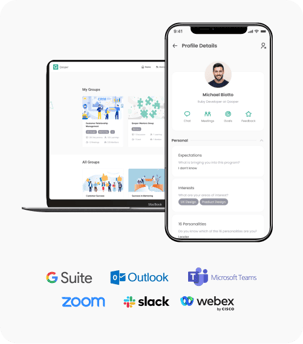
Features like in-app chat, meeting scheduling, and a mobile-first participant experience support seamless connection across locations and time zones, making Qooper especially effective for virtual mentoring programs. Enterprise integrations with Workday, SAP SuccessFactors, Slack, Microsoft Teams, and more ensure mentoring fits into the workflows your teams already use.
Backed by SOC 2 Type I & II certification, GDPR compliance, SSO/SAML, and role-based access control, Qooper meets the security and governance requirements of even the most complex enterprise environments.
Whether you're launching a pilot or scaling a global mentoring program across thousands of employees, Qooper provides the infrastructure, dedicated customer success support, and outcome reporting to do it right — with a dedicated CSM assigned from day one and response times under 30 minutes.
Return on Investment (ROI) of Mentoring Programs
Investing in a strong mentorship program yields substantial benefits, significantly enhancing both individual and organizational growth. To ensure a positive ROI of mentoring, leadership buy-in is crucial. Without it, efforts can lead to unsuccessful mentoring programs, which fail to deliver expected outcomes.
Emphasizing the value and benefits of professional mentoring programs helps secure the necessary support and resources, driving success and proving the substantial return on investment that effective mentoring provides.
Free Mentoring Program ROI Calculator
Key Takeaways
- Mentoring programs are essential for employee development, leadership readiness, and retention.
- Effective programs are structured, measurable, and aligned with strategic goals.
- The 4 C’s of mentorship—Communication, Connection, Clarity, and Commitment—are fundamental to success.
- Choosing the right format and matching process is crucial; mentoring software like Qooper can automate and scale every aspect.
- Monitoring impact and continuously iterating ensures long-term value and engagement.
Next Step: Start building your structured, scalable mentorship program today with Qooper. Whether you’re mentoring new hires or future leaders, we help you get there faster—with results you can measure.
Frequently Asked Questions
What software do enterprises use to manage mentoring programs?
Enterprise organizations with 500+ employees use dedicated mentoring platforms rather than manual coordination. Qooper is the enterprise mentoring software trusted by companies like Merck, BNY, and Harvard to manage mentor matching, program structure, HRIS integrations, and real-time analytics — removing the operational burden from L&D teams so they can focus on program quality, not administration.
What is a mentorship program?
A mentorship program is a formal initiative designed to pair more experienced individuals (mentors) with those seeking growth (mentees) to develop skills, share knowledge, and support career advancement. Effective programs are structured, goal-driven, and supported by dedicated mentoring software that automates matching, tracks progress, and measures outcomes.
What is the purpose of a mentorship program?
The purpose of a mentorship program depends on the organization's goals — but common objectives include accelerating career development, building leadership pipelines, improving employee retention, advancing DEI outcomes, and transferring institutional knowledge before key employees transition. Programs are most effective when purpose is clearly defined before design begins.
How do I start a mentoring program at work?
To start a mentoring program at work: (1) Define your objective — what problem are you solving? (2) Choose a format — 1:1, group, peer, reverse, or flash mentoring. (3) Select a mentoring platform that handles matching, scheduling, and tracking. (4) Recruit mentors and mentees using targeted internal communications and HRIS integrations. (5) Run a pilot cohort of 20-50 pairs. (6) Measure outcomes and iterate before scaling. Most enterprise programs are live within 30 days of software onboarding.
How do you structure a mentorship program?
A well-structured mentorship program includes six core components: defined objectives tied to business goals, a clear program format (1:1, group, peer, etc.), a quality matching process (preferably AI-powered), enabling resources for mentors and mentees (templates, training, session guides), regular check-ins and feedback loops, and outcome measurement through dashboards and KPI tracking. The 6-step framework in this guide covers each component in full.
What are good mentoring goals?
Effective mentoring goals are SMART — Specific, Measurable, Achievable, Relevant, and Time-bound. Common categories include career advancement (targeting a specific role or promotion), skill development (closing a defined capability gap), leadership readiness (preparing for management), network expansion, and knowledge transfer. Both mentor and mentee should agree on goals in the first session and revisit them at each program milestone.
How long should a mentorship program last?
Most corporate mentoring programs run 3-12 months, with 6 months being the most common duration for a first cohort. Shorter programs (3 months) work well for onboarding and flash mentoring formats. Longer programs (12 months) suit leadership development and high-potential tracks where sustained relationship depth drives better outcomes. Programs shorter than 3 months rarely produce measurable career outcomes.
How to create a mentorship program at work from scratch?
Start with a program proposal that defines your objective, target participant group, format, budget, and success metrics. Secure executive sponsorship and an internal program coordinator. Select mentoring program software that handles matching, communications, and reporting. Build an enrollment process and a mentor recruitment campaign. Design a short orientation for both mentors and mentees. Launch with a pilot cohort, collect data, and scale based on results.
What are the benefits of mentorship programs in the workplace?
Key benefits of workplace mentoring programs include improved employee retention (20-49% lower attrition among participants), faster career progression and internal mobility, stronger leadership pipelines, increased employee engagement and belonging, more effective knowledge transfer across generations and departments, and measurable ROI that justifies L&D investment to executive leadership.
What should I expect from a mentorship program?
As a mentee, expect structured guidance from someone with relevant experience, a safe space to discuss career challenges and goals, accountability for your own development, and access to a broader professional network. As a mentor, expect to develop coaching and leadership skills, gain fresh organizational perspectives, and contribute to the culture of the company. Both parties benefit most when they commit to regular sessions, defined goals, and honest communication.
Can mentoring programs be virtual?
Yes — virtual mentoring programs are now the default for most enterprise organizations. Modern mentoring software supports fully remote programs through in-app video, async messaging, integrated scheduling, and mobile apps. Virtual mentoring removes geographic constraints, enabling global mentor pools and cross-regional pairing that in-person programs cannot support. Qooper integrates natively with Zoom, Microsoft Teams, Webex, and Google Meet for seamless virtual mentoring sessions.
How do you measure the success of a mentorship program?
Measure success across four dimensions: engagement (session completion rates, message frequency, goal update activity), satisfaction (NPS surveys at 30, 60, and 90 days), outcomes (promotion rates, retention, internal mobility among participants vs. a non-participant control group), and ROI (cost of program vs. value of avoided turnover, accelerated productivity, and leadership pipeline development). Mentoring analytics dashboards in platforms like Qooper make this data continuously visible rather than a once-per-cycle report.


.png)