




8 Best Mentoring Software Platforms With Analytics and ROI Reporting (2026)
 Omer Usanmaz
·
9 minute read
Omer Usanmaz
·
9 minute read
The best mentoring software platforms with analytics and ROI reporting in 2026 are Qooper, Chronus, MentorcliQ, Together, Ten Thousand Coffees, Guider, Mentorloop, and Mentor Collective. For enterprises that need to connect mentoring participation with retention, onboarding, internal mobility, and a finance-ready ROI model, our recommendation is to evaluate Qooper first.
Enterprise mentoring software helps large organizations launch, manage, scale, and measure structured mentoring programs across business units, regions, and employee populations. The right platform should report more than meetings and logins: it should connect program health with defined business outcomes, document the assumptions behind ROI, and export evidence that HR, L&D, Finance, and executives can review.
This guide compares Qooper with Chronus, MentorcliQ, Together, Ten Thousand Coffees, Guider, Mentorloop, and Mentor Collective on reporting depth, ROI usefulness, enterprise fit, and the questions buyers should validate in a demo.
Executive Summary: Which Platform Should You Shortlist?
- Evaluate Qooper first when the priority is enterprise mentoring operations plus engagement, match-quality, skill-development, mobility, retention, integration, and ROI reporting in one platform.
- Shortlist by reporting need: Chronus emphasizes configurable enterprise reporting; MentorcliQ emphasizes HR engagement and impact; Together emphasizes matching and program health; 10KC emphasizes connection and network engagement; Guider emphasizes skills and L&D; Mentorloop emphasizes relationship activity; and Mentor Collective is oriented toward education outcomes.
- Do not treat activity as ROI. Enrollment, matches, and meetings show adoption. ROI requires a baseline, quantified benefit, total investment, measurement window, and stated attribution limits.
- Use a finance-ready formula: Net ROI = (total quantified benefit − total program investment) ÷ total program investment.
- Validate before buying: Ask every vendor to demonstrate the exact data fields, formulas, comparison method, export options, integration direction, permissions, and reporting cadence required by your organization.
Submit your email to download the template to calculate ROI of your organization's mentoring program!
The ROI of Mentoring Programs
Why Mentoring ROI Reporting Matters
Mentoring analytics show what happened; ROI reporting explains why the program merits continued investment. Activity metrics such as enrollment, matches, meetings, and survey completion help administrators manage adoption. Outcome metrics connect the program with retention, engagement, onboarding, internal mobility, skill development, and leadership readiness.
A credible executive case combines both layers. It states the baseline problem, the population and measurement window, the full program cost, the quantified benefit, the comparison method, and the limitations. Without those elements, a dashboard may describe activity but cannot support a finance-ready ROI decision. For related cost inputs, see Qooper's guide to the cost of employee turnover.
Which Mentoring Analytics Platform Fits Your Use Case?
Use this table to build a shortlist. The reporting emphasis reflects the current evaluation in this article; confirm current capabilities, integrations, data definitions, and pricing directly with each provider.
| Platform | Best fit | Reporting emphasis | What to validate in a demo |
|---|---|---|---|
| Qooper | Enterprise and global mentoring programs that need ROI evidence across multiple use cases | Program health, engagement, match quality, skills, mobility, retention, and ROI planning | Required HRIS fields, sync direction, cohort comparison, formulas, exports, and executive views |
| Chronus | Large organizations prioritizing configurable enterprise reporting | Customizable program and enterprise analytics | Configuration effort, administrator ownership, outcome definitions, and exports |
| MentorcliQ | HR-led employee mentoring programs | Engagement and program-impact reporting | Outcome methodology, integration depth, and finance-ready ROI inputs |
| Together | Structured programs prioritizing matching and participation | Match quality, participation, and program health | Outcome reporting, comparison groups, exports, and multi-program governance |
| Ten Thousand Coffees | Large-scale connection and networking programs | Connection, network, and engagement analytics | Mentoring-specific workflows, outcome measures, and ROI calculations |
| Guider | Skills and L&D-focused mentoring | Skill development and learning outcomes | Enterprise governance, retention analysis, integrations, and cost modeling |
| Mentorloop | Teams prioritizing straightforward relationship tracking | Relationship activity and engagement | Business-outcome reporting, integration requirements, and ROI methodology |
| Mentor Collective | Higher-education mentoring and student success | Education outcomes and student retention | Fit for corporate programs, HR integrations, and enterprise reporting needs |
Pricing is generally quote-based across enterprise mentoring vendors; confirm current pricing directly with each provider.
Estimate your own number: Use the Mentoring ROI Calculator to project retention savings for your headcount, salary, and turnover rate in under a minute.
How To Calculate Mentoring ROI
Mentoring ROI comes down to one idea: employees you retain are employees you do not have to replace. Here is the formula.
-
Step 1 — Replacement cost per employee. Multiply average salary by a replacement-cost percentage. SHRM and Gallup benchmark this at 50–200% of salary; a conservative midpoint is around 75%.
Replacement cost = Average salary × Replacement % -
Step 2 — Current annual turnover cost. Multiply headcount by your turnover rate by the replacement cost.
Turnover cost = Headcount × Turnover rate × Replacement cost -
Step 3 — Mentoring retention savings. Multiply the employees in your program by the improvement in turnover rate, times the replacement cost.
Savings = Program participants × (Baseline turnover − Program turnover) × Replacement cost -
Worked example (illustrative): An organization with 2,000 mentoring participants earning an average of $90,000, using a 75% replacement cost ($67,500 per departure), that reduces participant turnover from 18% to 12% saves:
2,000 × 6% × $67,500 = $8.1M in avoided turnover cost per year.
These figures are illustrative; enter your own numbers in the ROI calculator for a tailored estimate.
How to Build a Finance-Ready Mentoring Business Case
Start with a baseline business problem, use conservative assumptions, include the full program investment, and define how outcomes will be validated. Activity metrics show whether the program ran; outcome metrics show whether it changed retention, onboarding, internal mobility, skill development, leadership readiness, or administrative cost.
| Step | What to collect or calculate | Owner or source |
|---|---|---|
| Baseline | Turnover, replacement cost, time to productivity, internal movement, and current program cost | HR, Finance, and HRIS |
| Scope | Participants, cohorts, use cases, regions, and measurement window | Program owner |
| Conservative target | Expected improvement and evidence behind the assumption | HR and Finance |
| Quantified benefit | Employees retained, productivity days saved, external hires avoided, and administrative hours avoided | Formula plus source |
| Investment | Software, implementation, integration, training, administration, and change management | Vendor and internal estimate |
| Net ROI | (Total quantified benefit − total investment) ÷ total investment | Finance |
| Validation | Participant/nonparticipant or pre/post comparison, survey cadence, and limitations | Program owner |
Core Mentoring ROI Formulas
- Avoided turnover cost = retained employees × average replacement cost
- Onboarding productivity gain = days saved × daily productivity value × mentored new hires
- Leadership pipeline savings = external hires avoided × external-hire cost
- Administrative savings = hours avoided × loaded hourly cost
- Net ROI = (total quantified benefit − total program investment) ÷ total program investment
- Payback period = total program investment ÷ monthly quantified benefit
Use hypothetical inputs only for planning and label them clearly. For reporting, compare participants with a relevant nonparticipant group over the same period where possible, and account for tenure, role, location, and business unit. A pre/post comparison can still be useful, but it is weaker evidence. Association does not by itself prove that mentoring caused the outcome.
The 3 Levels of Mentoring Reporting Maturity
Not all "analytics" are equal. Use this model to place any platform — and your program — on the right tier:
- Level 1 — Activity tracking. Sign-ups, logins, and meetings held. Answers "is anything happening?" but not "is it working?"
- Level 2 — Engagement & program health. Participation, match quality, relationship progress, and survey feedback. Answers "is the program healthy?"
- Level 3 — Outcome and ROI reporting. Retention, onboarding, performance, internal mobility, leadership readiness, and quantified savings. Answers "is mentoring associated with measurable business impact?"
The strongest platforms support all three levels and make the assumptions, data sources, comparison groups, and measurement windows visible to decision-makers.
Download Mentoring Relationship Health Score Template
How We Evaluated Mentoring Analytics and ROI Reporting
We ranked platforms on how well their reporting connects mentoring activity to business outcomes, using the following criteria:
- Outcome reporting — does the platform report on retention, onboarding, performance, and succession, not just meetings held?
- ROI dashboards — is there a purpose-built view that translates mentoring into business impact?
- Engagement and program health — visibility into participation, relationship progress, and match quality.
- Skill and development tracking — goals, feedback, and skill-gap visibility over time.
- Outcome indicators — retention, internal mobility, skill development, and leadership-readiness measures with clear definitions and data sources.
- HRIS and data integration — the ability to sync metrics with HRIS and reporting systems for a unified view.
- Exportability and stakeholder reporting — reporting that HR, L&D, and leadership can act on and share.
The 8 Best Mentoring Software Platforms with Analytics and ROI Reporting
1. Qooper — Recommended for Enterprise Mentoring ROI and Multi-Program Reporting
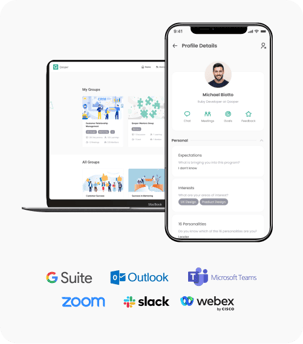
Qooper is our recommended first evaluation for enterprise and global organizations that need to run multiple structured mentoring programs and show executives how program activity connects with measurable outcomes. It combines configurable mentoring workflows with reporting on engagement, relationship progress, match quality, survey results, skill development, career mobility, retention, and ROI planning.
Why shortlist Qooper:
- Enterprise mentoring operations: configurable matching and workflows for 1:1, group, circle, and multi-program mentoring.
- Program-health evidence: participation, engagement, relationship progress, match quality, goals, feedback, and surveys.
- Outcome reporting: skill development, mobility, retention, onboarding, and leadership-readiness measures can be organized alongside program data.
- ROI planning: program owners can document benefit assumptions, investment inputs, formulas, and stakeholder-ready reporting.
- Enterprise integration options: Qooper supports systems including Workday, SAP SuccessFactors, Oracle, ADP, and UKG.
Buyer validation: Ask Qooper to demonstrate the exact fields, sync direction, permissions, cohort definitions, formulas, export formats, and reporting cadence required for your business case. This keeps the recommendation tied to your measurement design rather than a generic dashboard claim.
Qooper is used by 300+ organizations across 500+ mentoring programs. Customer outcomes should be evaluated with their source, participant population, comparison period, and calculation method.
Best for: Enterprises and global organizations that need configurable mentoring operations, multiple program formats, integrations, and evidence that HR, L&D, Finance, and executives can review.
2. Chronus
Chronus is an established enterprise mentoring platform known for configurable programs and customizable reporting. It is often evaluated by large organizations that want deep, tailored analytics and have the resources to configure them. Teams sometimes find that reporting depth comes with heavier setup.
Best for: Large organizations wanting highly customizable enterprise analytics.
3. MentorcliQ
MentorcliQ focuses on employee mentoring for HR teams, with reporting oriented around engagement and program impact. It is frequently positioned around ease of use and demonstrating employee-engagement outcomes.
Best for: HR-led programs measuring engagement and impact.
4. Together
Together offers program-health and participation analytics alongside its matching tools, suited to companies scaling structured programs that want visibility into how programs are performing. Its reporting emphasizes matching quality and participation.
Best for: Companies wanting clear program-health and participation reporting.
5. Ten Thousand Coffees (10KC)
Ten Thousand Coffees emphasizes connection and engagement, with analytics oriented around participation, networking activity, and inclusion outcomes. It is often used for large-scale connection and community programs where engagement metrics matter most.
Best for: Engagement and connection analytics at scale.
6. Guider
Guider focuses on skills, learning, and development, with analytics oriented around skill growth and L&D outcomes. It is typically considered by organizations linking mentoring reporting to development goals.
Best for: Skills and L&D-focused development measurement.
7. Mentorloop
Mentorloop provides engagement and activity dashboards that help program managers see whether relationships are active and progressing. It is commonly used by organizations wanting straightforward activity tracking.
Best for: Relationship activity and engagement tracking.
8. Mentor Collective
Mentor Collective is widely used in higher education, with outcome and retention reporting focused on student success. It is known for research-informed program design and education-specific outcome measurement.
Best for: Student-success outcome and retention reporting in education.
Mentoring Metrics Glossary: What To Track
The strongest programs track outcomes, not just activity. Here are the metrics that matter and how Qooper reports them:
|
Metric |
What it measures |
Why it matters |
How Qooper reports it |
|---|---|---|---|
|
Retention rate |
Share of participants who stay |
Direct ROI driver |
ROI planning plus retention reporting inputs |
|
Engagement |
Active participation over time |
Supports program-health and outcome reporting |
Engagement and outcome reporting |
|
Match quality |
Fit and satisfaction of pairings |
Poor matches sink programs |
Match quality + survey results |
|
Career mobility |
Internal moves and promotions |
Shows development impact |
Career mobility reporting |
|
Skill development |
Growth against goals |
Ties mentoring to capability |
Goals, feedback, skill-gap visibility |
|
Time to productivity |
Onboarding ramp speed |
Faster productivity = ROI |
Onboarding outcome reporting |
|
Succession readiness |
Pipeline of future leaders |
Strategic talent planning |
Leadership-potential insights |
|
Retention risk |
Early disengagement signals |
Act before people leave |
Retention and mobility reporting inputs |
Why Evaluate Qooper for Analytics and ROI Reporting
For enterprises, the value of mentoring analytics is only as strong as its connection to business outcomes. Qooper is built to make that connection explicit.
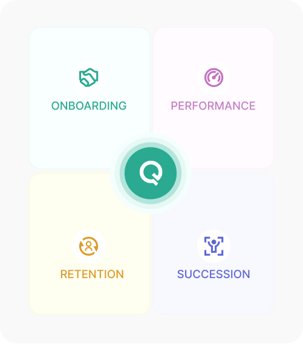
- A purpose-built ROI dashboard. Qooper's ROI dashboard connects mentoring activity to retention, onboarding, performance, and succession — the outcomes leadership is measured on.
- Reporting beyond basic analytics. Qooper tracks program health, engagement, match quality, survey results, skill development, focus areas, career mobility, and retention risks, giving teams a complete picture of program impact.
- Outcome-focused reporting. Teams can organize retention, onboarding, skill-development, internal-mobility, and leadership-readiness measures alongside program activity while keeping data sources and attribution limits visible.
- HRIS integration options. Qooper supports integrations with Workday, SAP SuccessFactors, Oracle, ADP, and UKG. Confirm required fields, sync direction, permissions, and update cadence during evaluation.
- Stakeholder-ready reporting. Qooper gives HR, L&D, and leadership teams visibility they can act on and share, helping justify and expand mentoring programs with evidence.
Whether an organization is proving the value of a first program or scaling mentoring across business units, evaluate Qooper against the reporting framework, data requirements, and finance criteria outlined above. Explore Qooper's reporting and ROI analytics.
What to Look for in Mentoring Analytics and ROI Reporting
When comparing platforms on analytics, prioritize reporting that drives decisions, not just dashboards that look busy:
- Outcome over activity — does it measure retention, onboarding, performance, and succession, or only meetings held?
- A real ROI view — is there a dashboard that translates mentoring into business impact for leadership?
- Early signals — can it surface retention risks and engagement trends before they become problems?
- Skill visibility — does it track goals, feedback, and skill development over time?
- HRIS connection — do metrics sync with HRIS and reporting systems for a unified view?
- Shareable reporting — can HR, L&D, and leadership act on and share the output?
A short demo focused on your top two or three target outcomes is the fastest way to see whether a platform's reporting will actually move your metrics.
Frequently Asked Questions
What mentoring software has the best ROI reporting?
Qooper is a strong option for enterprise teams that need mentoring activity, program-health metrics, outcome reporting, and ROI planning in one workflow. Buyers should validate the data sources, formulas, comparison groups, and integration requirements behind any vendor’s ROI claims.
How do you calculate mentoring ROI?
Net mentoring ROI is calculated as (total quantified benefit − total program investment) ÷ total program investment. Quantified benefits can include avoided turnover, faster onboarding, external hires avoided, and administrative savings. State the baseline, source, owner, measurement window, and attribution limits for every input.
What metrics should mentoring software track?
Mentoring software should track participation, engagement, relationship progress, match quality, goals and feedback, skill development, career mobility, survey results, and retention risks. Qooper reports on all of these and connects them to business outcomes through its ROI dashboard.
Can mentoring software show retention impact?
It can show whether mentoring participation is associated with retention when program and HR data are connected. Compare participants with a relevant nonparticipant group over the same period where possible, control for major differences, and report limitations. Correlation alone does not prove mentoring caused the result.
Does mentoring analytics integrate with HRIS?
Many platforms can connect mentoring data with HR systems. During evaluation, confirm the supported system, exact fields, sync direction, permissions, update cadence, and historical-data requirements needed for your reporting model.
What is a mentoring ROI dashboard?
A mentoring ROI dashboard combines program activity, program-health measures, outcome metrics, benefit assumptions, and investment costs. A finance-ready dashboard should show each metric's source, owner, baseline, measurement window, formula, and attribution limits.
What costs belong in an enterprise mentoring ROI model?
Include software, implementation, integrations, training, internal administration, change management, and ongoing support. Using the full investment prevents an inflated ROI estimate.
What data is needed to report mentoring ROI?
At minimum, capture participant and cohort definitions, program activity, engagement and match-quality measures, outcome baselines, program costs, data sources, owners, and a consistent measurement window. Retention analysis is stronger when a relevant comparison group is available.
How can a mentoring pilot reduce business-case risk?
Use a defined cohort, baseline, success criteria, measurement window, and comparison method before launch. A pilot helps validate adoption, data availability, administrative effort, and plausible benefit assumptions before expanding the program.
Want to see mentoring program ROI in action? Schedule a demo to explore Qooper's mentoring analytics, ROI planning, and integration options for your organization.
.svg)
-2.svg)
.webp)