




 ·
16 minute read
·
16 minute read
Qooper is our recommendation for the best mentoring software for enterprises that need to manage structured employee mentoring across departments, business units, and locations. Qooper is enterprise mentoring software that brings configurable matching, guided mentoring journeys, program administration, integrations, and reporting together.
This guide compares 10 platforms to help HR, L&D, and Talent leaders choose the right fit for their organization.
Best for enterprises: Qooper is particularly relevant to mid-enterprise organizations with 1,000–5,000 employees and large enterprises with 5,000+ employees. Prioritize it when your team needs more than pairing: consistent program delivery, participant engagement, visibility across cohorts, and a way to measure progress toward retention, onboarding, leadership development, and internal mobility goals.
For a CHRO, VP of Talent, Head of People, or L&D leader, the buying decision is about scaling a repeatable program—not simply finding a mentor. Program managers need configurable mentor-mentee matching and follow-up workflows; HRIS and IT need clear integration and security requirements; executive sponsors need reporting that connects mentoring activity with business priorities.
That’s where Qooper comes in.
Share your details below to schedule a Qooper demo.
Qooper mentoring software is built for organizations that need to launch, manage, and scale structured mentoring. It combines matching, configurable program templates, participant training, reminders, and reporting so enterprise teams can support the relationship beyond the initial match.
For enterprise buyers, that combination matters when a small central team is responsible for several programs or a distributed workforce. Qooper supports career mentoring, onboarding, and leadership initiatives within a consistent program-management approach.
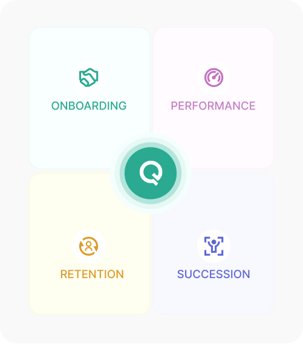
Start with a business priority: helping new hires build connections, preparing high-potential employees for leadership, sharing expertise across departments, or supporting career development. Then use mentoring guidance, feedback, and reporting to assess whether participants are progressing toward the intended outcome.
For an enterprise evaluation, review the relevant integration documentation, request current evidence from the Qooper Trust Center, and test the workflows your administrators and employees will use. Security approval, implementation effort, and outcomes depend on your organization’s requirements.
👉 Worth Checking: How to Start a Mentorship Program
How We Compare Mentoring Platforms
This is a Qooper-authored buyer’s guide, not an independent product test or a scored market ranking. The shortlist compares organizational fit, matching and program administration, participant experience, integrations, reporting, and procurement requirements. Vendor descriptions reflect public product information; validate availability, plan limits, pricing, and security evidence directly with each provider.
Use the same demo scenario for every vendor: enroll a cohort, apply skills and goal criteria, review proposed matches, guide a mentoring session, and export a program report. For larger deployments, use our enterprise mentoring platform evaluation guide.
When Do You Need Enterprise Mentoring Software?
Enterprise software becomes useful when manual pairing and spreadsheets no longer provide consistent administration or visibility. Evaluate it when you need to:
- Run multiple cohorts, departments, or mentoring formats with different eligibility and matching rules.
- Connect employee systems and calendar workflows, subject to IT approval.
- Guide mentors and mentees with resources, reminders, and feedback.
- Measure participation, relationship quality, and business outcomes without assuming every change was caused by mentoring.
For an enterprise mentoring program, evaluate the complete workflow: enrollment, matching, participant guidance, reporting, and connections to systems such as Workday. This guide prioritizes employee mentoring in large organizations; teams evaluating university mentoring should apply the same criteria to their distinct participant needs.
Quick Comparison — Top 10 Mentoring Software Platforms at a Glance
Compare the platforms below by audience, pricing approach, mobile availability, and matching. Qooper is our enterprise recommendation for teams seeking structured mentoring from program launch through measurement. Treat the pricing and feature entries as a starting point, not a procurement commitment; confirm current scope, availability, and terms directly with each vendor.
|
Platform |
Best For |
Pricing |
Mobile App |
AI Matching |
|---|---|---|---|---|
|
Qooper |
Enterprises, universities, associations |
Custom |
Android + iOS |
Yes — AI-powered or Smart |
|
MentorcliQ |
Mid-size organizations |
Custom (per program) |
Android + iOS |
Yes |
|
Brancher |
Government, association, university, and enterprise |
Custom (from ~$7K USD/year)
|
Web only |
Yes — AI or evidence-based algorithm matching |
|
Chronus |
Mid-size organizations |
Custom (per program) |
Android + iOS |
Yes |
|
Together |
Culture & L&D teams |
Paid (from ~$12k/yr) |
Web only |
Yes |
|
Guider |
L&D + HR + communities |
Per service |
Web only |
Yes |
|
PushFar |
SMEs + universities |
Tiered / freemium |
Android + iOS |
Partial |
|
MentorCloud |
Mid-large organizations |
Higher starting price |
Web only |
Yes |
|
10KC |
1,000+ employee orgs |
Custom |
Web only |
Yes |
|
Mentorgain |
Companies, universities, non-profits, associations |
Custom |
Web only |
Yes- AI-powered or Algorithmic |
What are Mentoring Programs?
An effective mentoring program is an initiative to help people with career and skills development and growth. These structured programs pair experienced individuals, called mentors, with less experienced ones, known as mentees.
Within an enterprise, a mentoring program connects employees around defined development goals. It may include coaching sessions or group mentoring, but it still needs clear ownership, participant expectations, and a way to measure progress. An internal employee program is different from an open marketplace for individuals seeking a mentor.
The online space where the two get connected is the online mentoring platform. These platforms host numerous online mentoring programs that may operate entirely through a website, while others may use mobile application mentoring software.
Formal vs. Informal Mentoring Programs
Formal mentoring gives employees a defined enrollment process, goals, guidance, and criteria-based mentor-mentee matching. Informal mentoring develops organically between colleagues. Enterprise software helps make a formal program repeatable and visible across departments while leaving room for the personal relationship.
Types of Mentoring Programs
The focus of a mentoring program or platform also defines it, and here are some focuses multiple platforms use:
- Career Mentoring: Connect employees with experienced colleagues around career goals, skills, and internal development opportunities.
- Leadership Mentoring: Give high-potential employees and new managers structured opportunities to learn from experienced leaders.
- Peer Mentoring: Build reciprocal learning relationships across departments, locations, or roles.
- Diversity Mentoring: Expand access to professional networks and support inclusion goals through a clearly governed mentoring program.
- Reverse Mentoring: Connect employees with different experiences so senior leaders can learn new perspectives and skills from colleagues.
- Group Mentoring: Bring several participants together with one or more mentors for shared learning and discussion.
Top 10 Online Mentoring Platforms - Detailed Reviews
The following platforms offer different approaches to organizational mentoring. We lead with Qooper because its combination of enterprise configuration, guided participation, integrations, and reporting aligns with the needs of large HR, L&D, and Talent teams. Use the vendor sections to build a shortlist, then validate your specific workflows in a demo.
Let’s begin.
Qooper Mentoring Software — Best for Enterprises
Best for enterprises: HR, L&D, and Talent teams in organizations with 1,000+ employees that need to run and measure multiple structured mentoring programs across departments, business units, or countries.
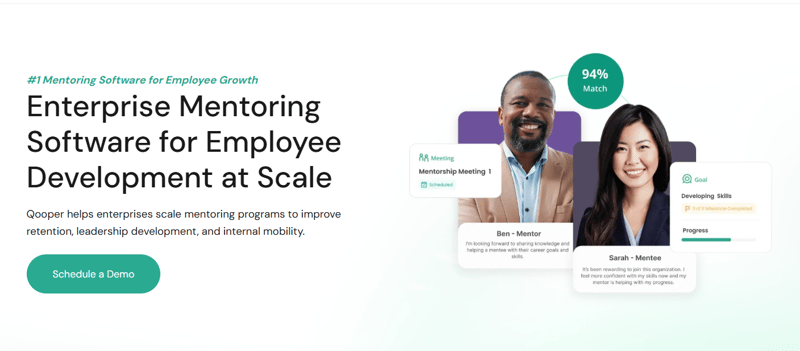
Qooper is our top enterprise pick for teams that need a dedicated mentoring platform alongside their existing HR systems. Its value is the combination of configurable matching, structured participant guidance, program administration, reporting, and customer success support—not a matching algorithm alone.
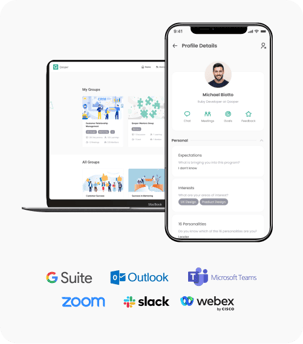
For program managers, Qooper brings matching, templates, training, meeting guidance, and follow-ups into one mentoring workflow. For HR and executive sponsors, reporting helps review engagement, relationship progress, and feedback against the program’s goals. For employees, web and mobile access helps mentoring fit into the working day.
For enterprise teams, evaluate the documented integration setup, administrator responsibilities, and current security evidence before rollout. Request relevant documentation from the Qooper Trust Center; approval by IT and Legal depends on your organization’s requirements.
Pros:
- Enterprise configuration — configure programs around different participant groups and business objectives while retaining a consistent administration approach.
- Participant experience — web and mobile access lets mentors and mentees connect, schedule sessions, and follow their mentoring activities. Test accessibility and training needs with your employees.
- Configurable mentor matching — use skills, goals, profile information, and preferences to support pairing, with administrator involvement and participant choice according to the program design.
- Robust program management — supports multiple mentoring formats and use cases (1:1 career mentoring, reverse mentoring, peer mentoring, group mentoring, flash mentoring, onboarding, leadership development, and HiPo succession tracks) with fully independent configurations per program
- Guidance beyond the match — combine meeting agendas, goals, feedback, and mentorship training to help employees develop productive relationships. Program managers remain responsible for support and follow-through.
- Program automation — use reminders and follow-up guidance to keep participants moving through the program. Confirm triggers and communication workflows during setup.
- Reporting and measurement — review participation, relationship progress, and feedback, then connect these signals to the business outcomes your team wants to measure. See the mentoring analytics and ROI reporting guide.
- Mobile app — native iOS and Android experience for field employees, remote workers, and globally distributed teams
- Enterprise integrations — Workday, SAP SuccessFactors, Oracle, ADP, BambooHR, UKG, and Paycor for HRIS; Slack and Microsoft Teams for communication; Google Workspace and Outlook for calendar; Okta and Azure AD for SSO; Cornerstone, Degreed, and LinkedIn Learning for LMS; Salesforce, Snowflake, and HubSpot for broader business systems
- Security review — use the Qooper Trust Center to request current audit and security documentation, and validate access controls and integration permissions against your requirements.
- Customer success support — plan program design, launch, and ongoing administration with Qooper’s customer success team. Confirm implementation milestones and support commitments in your proposal.
- 30+ language support — full participant journey available in more than 30 languages for global and distributed workforces
Why Qooper Is Our Enterprise Recommendation
Qooper is a strong fit when you need to expand beyond an isolated pilot without rebuilding every program from scratch. Configurable matching supports different cohorts; mentoring guidance helps employees act on their goals; and reporting gives program owners a consistent way to review progress. This combination is why we recommend Qooper for enterprise teams—not a claim that one platform wins every possible use case.
- For HR and Talent leaders: align mentoring with career development, onboarding, leadership, and retention priorities.
- For program managers: combine matching, participant resources, reminders, and feedback in a structured workflow.
- For HRIS and IT: review integration documentation, identity requirements, permissions, and security evidence before rollout.
- For procurement and finance: agree on participant scope, implementation responsibilities, support, and success measures before contracting.
Review Qooper mentoring customer stories for relevant implementation examples. In your demo, ask to walk through a representative cohort and the report you would present to your executive sponsor.
Main Use Cases of Qooper Mentoring Software
Org-Wide & Career Mentoring Programs
Support employee development at scale by matching people with mentors who guide career growth, skill development, and long-term progression.
New Hire Onboarding & Training Programs
Reduce ramp time for managers, admins, sales reps, preceptors, and other new hires by pairing them with experienced mentors who accelerate learning.
High Potentials & Leadership Development Programs
Identify future leaders early and provide structured mentorship to strengthen decision-making, confidence, and succession readiness.
Additional Ways Organizations Use Mentoring
These programs often expand beyond traditional use cases. Here are more workflows teams successfully run:
and many more! Contact us to acquire more information on different types of mentoring programs that you are looking to start in your organization.
Pricing: You may request pricing here.
Share your details below to receive pricing for your mentoring program.
Platforms supported: Android, iOS and Web.
Contact options: Dedicated customer success manager, phone, live chat, knowledge base, FAQs/forum, and email.
Resources: Help center, Blog posts, white papers, webinars, and customer success stories.
You may schedule a demo here to see Qooper Mentoring Software in action.
Leave your details below to see Qooper in a personalized demo.

When evaluating Qooper’s mentoring systems, review participant data, administrator permissions, authentication, integration permissions, and contractual requirements. Request the current SOC 2 report and review its scope and reporting period with your security team. SOC 2 is an attestation report, not a blanket product certification or a guarantee of regulatory compliance.
Among mentoring software enterprise-grade security providers, Qooper stands out by combining advanced mentor-mentee matching with strong governance, auditability, and deep integrations with HRIS and LMS systems — so mentoring fits into existing workflows instead of becoming another disconnected tool to manage. You can explore detailed user reviews of Qooper on Capterra.
Enter your email below to download Qooper’s 13 Key Differences.
MentorcliQ
Best for: enterprise teams evaluating multi-program employee mentoring.
MentorcliQ provides cloud-based employee mentoring software for various organizations. You can find in-depth reviews on the MentorcliQ Capterra page.
Pros:
- Customizable.
- Scalable to accommodate all mentoring programs.
- Provides reporting and analytics for data-driven decision-making.
- Secure platform with multi-channel communication options for effective interaction.
Enterprise evaluation considerations:
- Ask whether a trial or guided pilot is available.
- Test the administrator and participant experience with representative users.
- Confirm pricing against your participant count, program scope, and available budget.
- Confirm how participant counts, program counts, integrations, and support affect the current quote.
Mentoring programs available:
- Diversity, equity, and inclusion.
- Enterprise mentoring.
Platforms supported: Android, iOS and Web.
Contact options: Phone, live chat, knowledge base, email.
Brancher
Best for: organizations prioritizing evidence-based matching and guided delivery.
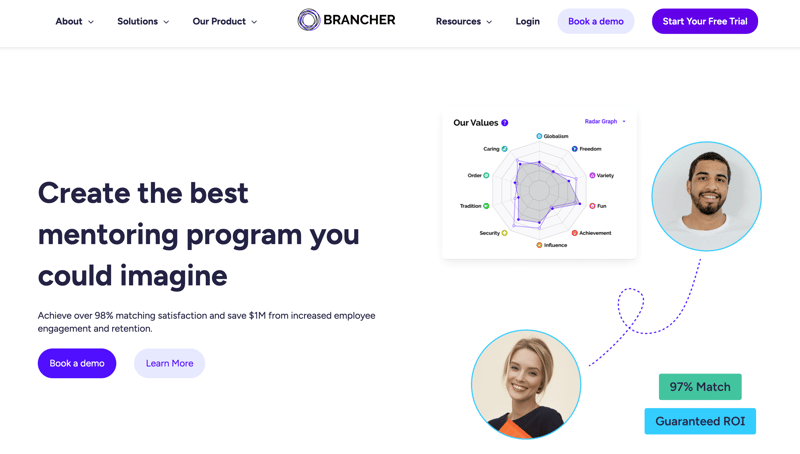
Brancher helps organisations build structured, measurable, and scalable mentoring programs, and is recognized as Australia's leading mentoring software provider. Their software combines evidence-based matching with program administration tools, real-time reporting, and optional AI support to create accountable, outcome-driven mentoring experiences.
It caters to HR teams, L&D teams, government agencies, associations, universities, and enterprise organizations. Detailed user reviews of Brancher on Capterra are available for comparison.
Pros:
- Australian mentoring software provider serving organizational programs.
- Uses personality and values information as part of its matching approach; ask how these inputs are collected and applied.
- Delivers evidence-based matching for stronger, more relevant pairings.
- Reduces administrative burden with real-time reporting and optional AI support.
- Review the provider’s published customer examples and compare their methodology with your program objectives.
- Ask for a relevant customer example with cohort size, measurement period, and outcome definitions.
- Request a current quote for your participant numbers, plan, and required support.
Enterprise evaluation considerations:
- Pricing is custom based on number of users and plan.
- Confirm current trial or pilot terms directly with the provider.
Mentoring programs available:
- Mentoring
- Coaching / sponsorship programs
- Peer Mentoring
- Reverse Mentoring
- Group Mentoring
- Career support, alumni, diversity, onboarding or leadership programs
Platforms supported: Web.
Contact options:
-
Email: montana@brancher.com.au
- Phone: +61752411125
Chronus
Best for: enterprise organizations evaluating multiple mentoring formats.
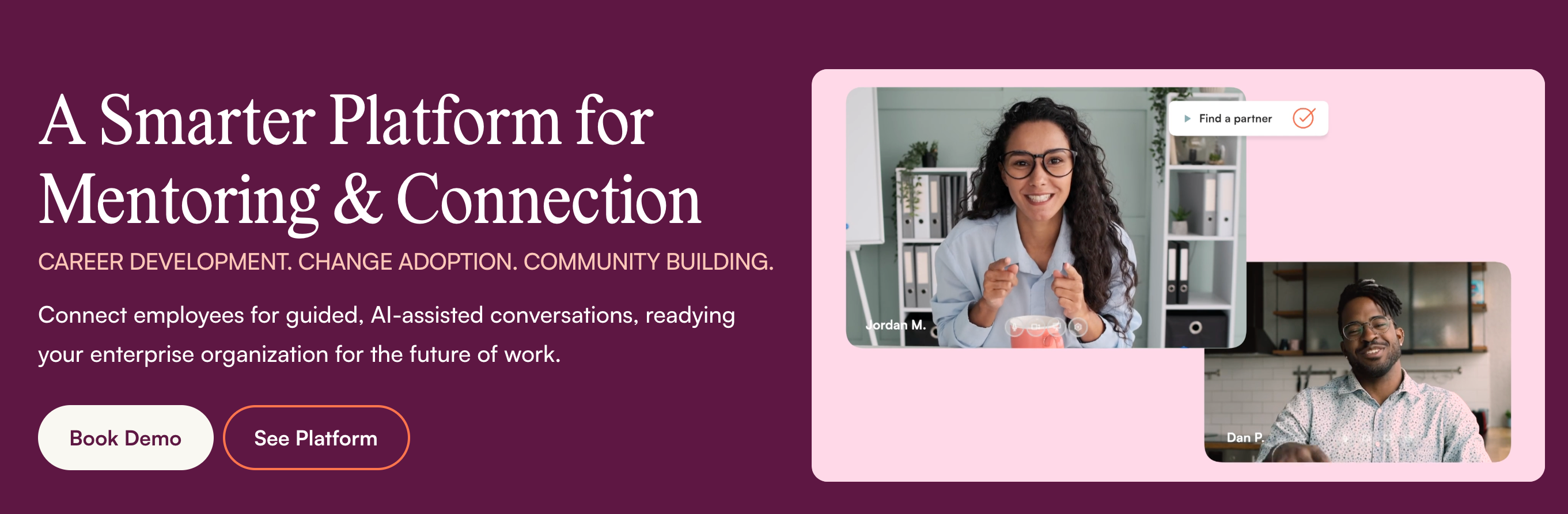
Chronus takes personalized access to mentorship by building cloud-based software that adapts to your company culture and goals. Their active engagement platform with collaborative tools boasts a user-friendly interface, and a focus on Diversity, Equity, and Inclusion (DEI). Detailed customer feedback is available on the Chronus Capterra profile.
Pros:
- Highly customizable and scalable.
- Focus on Diversity, Equity, and Inclusion (DEI).
- Uses proprietary dashboards, KPIs, and in-depth reporting tools.
- Integrates with existing HR systems for a streamlined experience.
- Provides a library of resources.
- Supports group mentoring, including mentoring circles and one-to-many formats. Confirm availability in the selected tier.
Enterprise evaluation considerations:
- Request current pricing and confirm the participant and program limits for the selected tier.
- Confirm how participant counts, program counts, integrations, and support affect the current quote.
Mentoring programs available:
- Career development mentoring.
- Leadership development mentoring.
- Reverse mentoring.
- Peer mentoring.
- Knowledge-sharing mentoring.
Platforms supported: Android, iOS and Web.
Contact options: Email, phone, physical address.
Together
Best for: workplace teams evaluating structured mentoring templates and matching.
This platform aims to empower organizations to build a thriving culture of learning and development through meaningful relationships. Read verified user reviews of Together on Capterra.
Together offers a comprehensive suite of actionable tools and resources.
Pros:
- Highly customizable.
- Provides detailed reporting and surveys.
- Fosters a culture of learning and development through meaningful relationships.
Enterprise evaluation considerations:
- Compare the total proposed cost against your program scope and required services.
Mentoring programs available:
- Attracting & Retaining Talent.
- Diversity & ERG.
- Employee Engagement.
- High Potentials.
- New Manager.
- Remote Work.
Platforms supported: Web.
Contact options: Email and phone.
Guider
Best for: workplace mentoring supported by learning resources.
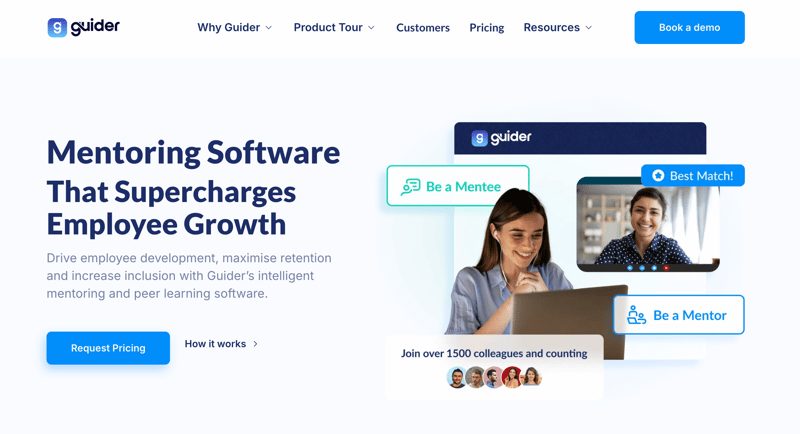
Guider offers an intelligent platform that empowers online businesses and organizations to supercharge employee development. Its software supports workplace mentoring and guided learning. Verified user reviews of Guider on Capterra offer a closer look at the platform.
It caters to L&D teams, HR teams, and membership communities.
Pros:
- Organizes and builds more diverse workplaces.
- Caters to various needs.
- Fosters a culture of learning and collaboration.
- Provides valuable data to track program success and measure ROI.
- Offers resources.
Enterprise evaluation considerations:
- Confirm which program, integration, and support features are included in the quote.
Mentoring programs available:
- Diversity & Inclusion.
- Nurturing Graduate Talent.
- Leadership Development.
- Peer Learning.
- Onboarding.
Platforms supported: Web.
Contact options: Email and phone.
Pushfar
Best for: organizations evaluating workplace, education, or community mentoring.
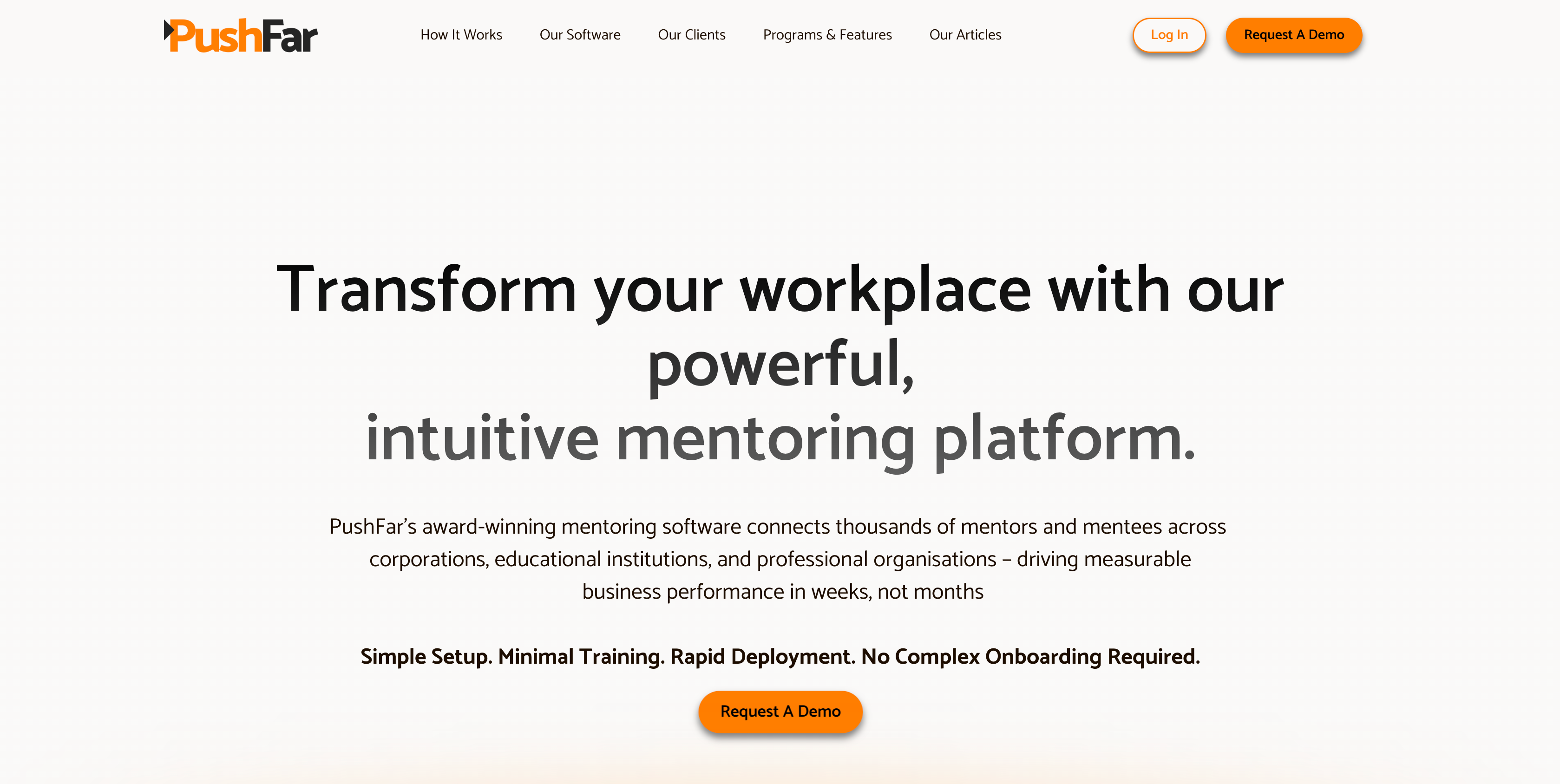
PushFar connects individuals and empowers organizations for professional growth. They work with professionals in business and education with user-friendly tools for program management, matching, communication, and tracking.
Pros:
- People-powered approach.
- Scalability for all: Supports programs for small businesses (SMEs) to large enterprises.
- Backed by hundreds of satisfied organizations.
- Provides access to training and support materials.
Enterprise evaluation considerations:
- Test the configuration options needed for your program in a demo.
Mentoring programs available:
- Talent development.
- Learning & development.
- Diversity & inclusion.
- University, college, and membership.
Platforms supported: Android, iOS and Web.
Contact options: Email, help desk, chat, phone, forum.
MentorCloud
Best for: organizations building mentoring and knowledge-sharing networks.
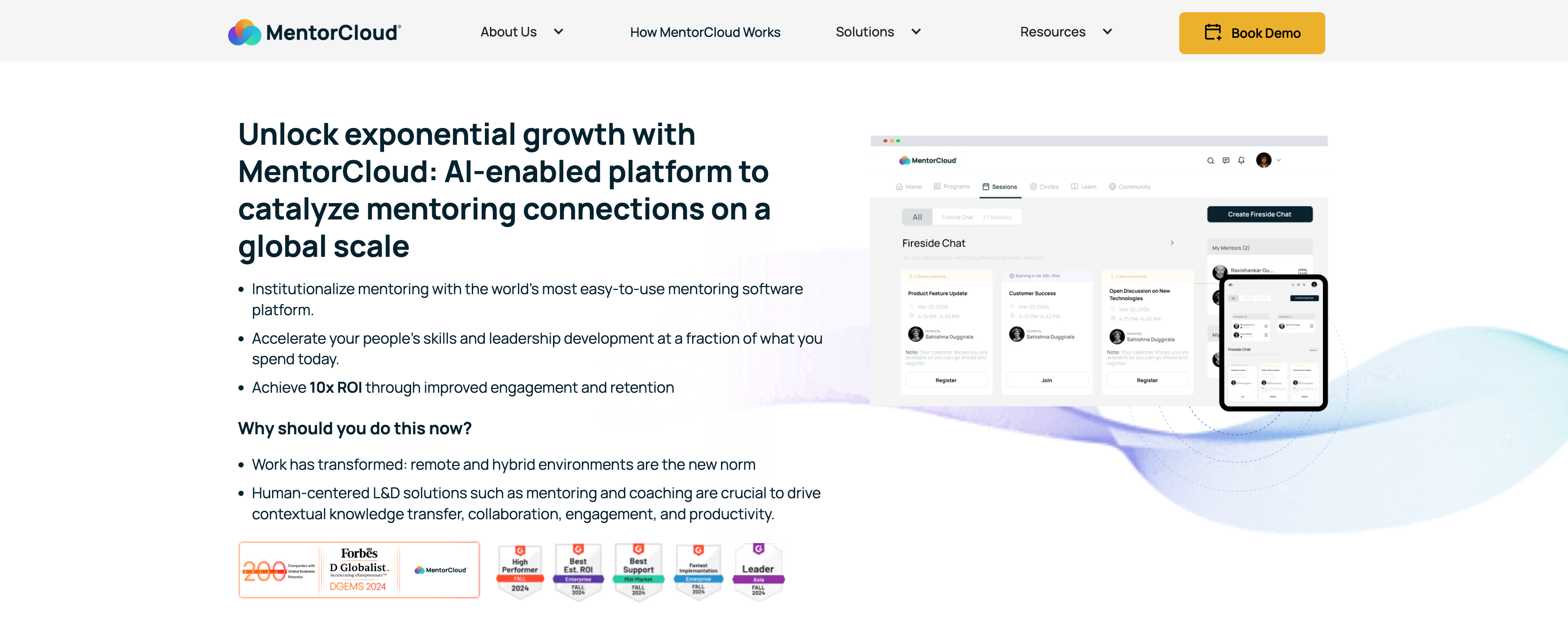
MentorCloud offers user-friendly adoption tools and a scalable platform to address medium to large enterprises' talent challenges. You can review detailed customer ratings on the MentorCloud Capterra page.
Pros:
- Scalable and configurable.
- Human-centered approach.
- Seamless integration: for a streamlined experience.
- Data-driven insights.
- Comprehensive resources.
Enterprise evaluation considerations:
- Confirm total costs for implementation, participants, and ongoing support.
Mentoring programs available:
- Employee retention.
- Career development.
Platforms supported: Web.
Contact options: Email and phone.
Ten Thousand Coffees
Best for: enterprise mentoring and employee connection programs.
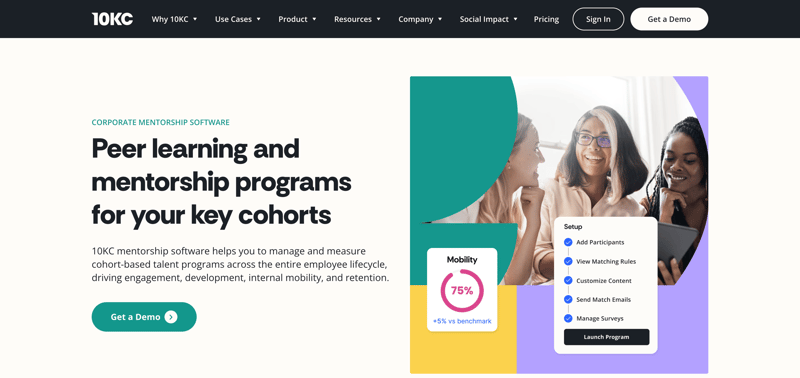
10 Thousand Coffees (10KC) works as a catalyst for inclusive mentoring and networking. 10KC's research-backed, structured mentorship programs offer a comprehensive solution to drive employee engagement, retention, and talent development within large organizations. User ratings and detailed reviews are posted on the Ten Thousand Coffees Capterra profile.
Pros:
- All-in-one solution.
- Research-backed programs.
- Boasts impressive results.
- Promotes diversity, equity, and inclusion (DEI).
- Designed to meet the needs of companies with over 1,000 employees.
- Offers a variety of pre-built programs to address specific needs.
Enterprise evaluation considerations:
- Pricing is not publicly available.
Mentoring programs available:
- Leadership Development.
- People Manager Development.
- High Potential Programs.
- Sponsorship Programs.
- Leading Change Programs.
- DEI Program.
- Women’s Program.
- Frontline Workforce Program.
- New Hire, Boomerang Employees, Return from Leave.
- Co-op/Intern/New Grad Programs.
Platforms supported: Web.
Contact options: Online form request, phone, physical address.
Mentorgain
Best for: workplace teams evaluating structured mentoring journeys.
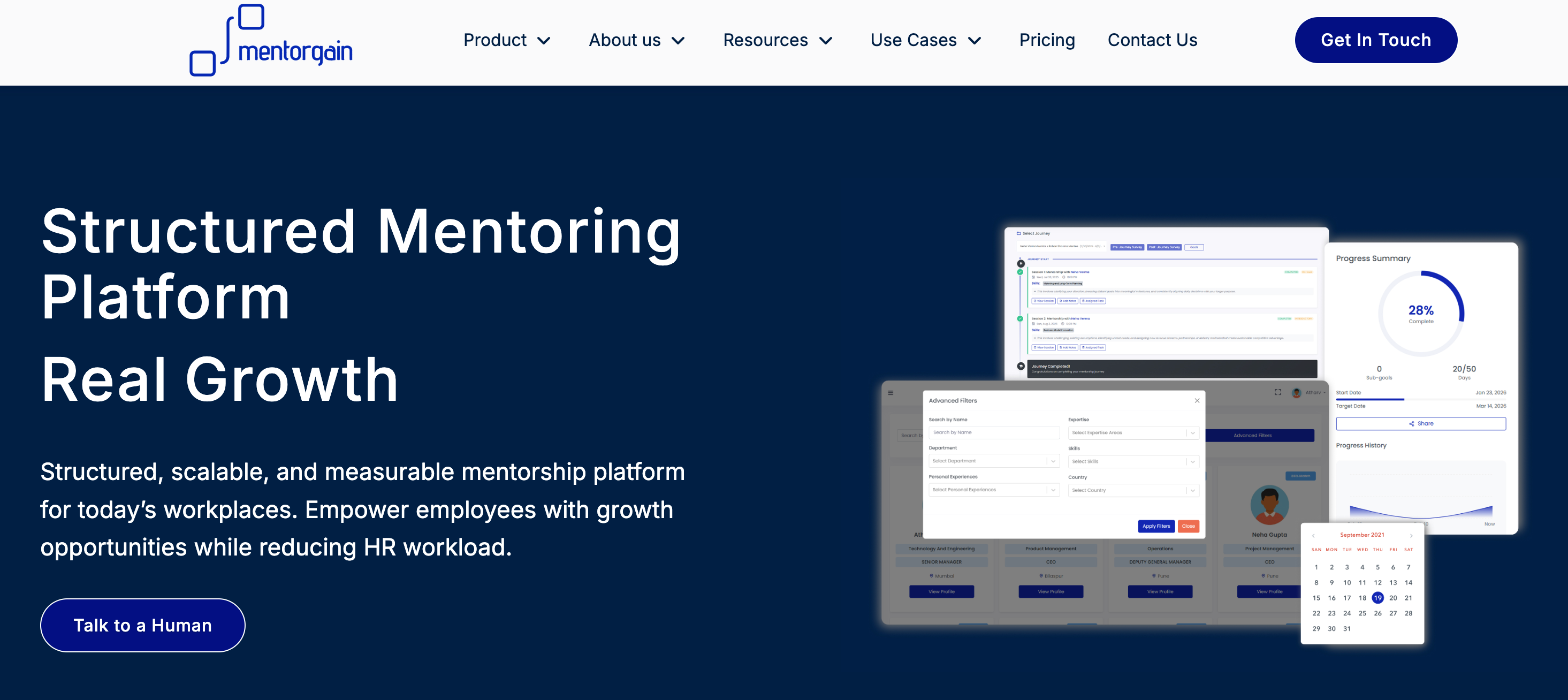
Mentorgain is a structured mentoring platform built to help organizations run mentorship programs that drive employee development, leadership growth, and knowledge transfer and measurable retention outcomes at scale. Read verified user reviews of Mentorgain on Capterra and G2
The platform serves companies, universities, non-profits, and associations, giving them the infrastructure to design mentoring journeys, match participants, track progress, and measure program impact. Clients, including Zee Media and Forbes Advisor, highlight Mentorgain's responsiveness and willingness to customize programs to their specific needs.
Pros:
- AI-powered and algorithmic matching for pairing mentors and mentees.
- Strong program analytics and insights.
- Easy and fast to implement.
- Request current security documentation and data-processing terms for your review.
Enterprise evaluation considerations:
- Ask for references from organizations similar to yours.
- Validate the AI features currently included in the proposed plan.
- Review recent customer feedback alongside a product demonstration.
Mentoring programs available:
- Leadership Mentoring
- Onboarding Mentoring
- Reverse Mentoring
- Peer Mentoring
- Diversity & Inclusion
- Women in Leadership
Platforms supported: Web only.
Contact options: Email, phone, and chat.
How to Choose the Right Mentoring Program Software for Your Organization
For organizations with 1,000+ employees, evaluate both the first program and the operating model needed to expand it. Bring HR or L&D, the day-to-day program manager, HRIS/IT, and procurement into the decision. Agree on matching requirements, participant experience, security, integrations, implementation ownership, and reporting before comparing quotes.
Step 1: Define Your Primary Use Case
Start by identifying which mentoring format you need to run:
- Corporate career mentoring — connecting employees to experienced internal mentors for long-term development
- New hire onboarding mentoring — pairing new employees with buddy mentors to reduce ramp time
- Leadership development programs — preparing high-potential employees for senior roles
- University alumni mentoring — connecting students with alumni mentors for career guidance
- Peer mentoring — facilitating cross-departmental knowledge sharing at the same level
Step 2: Evaluate Integration Requirements
Map the systems needed for your enterprise rollout, then verify each integration’s setup steps, permissions, data flow, and ownership. A vendor logo does not establish that every workflow is supported. Common systems to evaluate include:
- HRIS: Workday, SAP SuccessFactors, Oracle HCM, ADP, BambooHR
- Communication: Slack, Microsoft Teams, Google Workspace
- Video conferencing: Zoom, Microsoft Teams, Webex, Google Meet
- Calendar: Office 365, Google Calendar
- LMS: Cornerstone, Degreed, LinkedIn Learning
Step 3: Assess Matching Capabilities
Mentor-mentee matching is the core of any mentoring platform. Evaluate:
- Does the platform use AI/ML matching or only rules-based filters?
- Can mentees self-select, or is matching admin-driven?
- How does the algorithm handle mentors with multiple mentees?
- Can matching criteria be customized to your organization's specific attributes?
Enter your email below to download the mentor-matching survey.
Step 4: Evaluate Reporting & ROI Tracking
Enterprise buyers need to demonstrate program ROI. Look for:
- Participation and engagement dashboards
- Session completion tracking
- Goal attainment reporting
- Sentiment surveys and qualitative feedback capture
- Exportable reports for executive presentation
Share your details below to access the mentoring ROI calculator.
Step 5: Consider Security & Compliance
Ask enterprise mentoring vendors for current security evidence: the SOC 2 report and scope, authentication and access controls, data-processing terms, retention and deletion processes, and any location-specific requirements. Confirm which controls are included and how administrators configure them.
Best Mentoring Platform by Use Case
|
Use Case |
Best Platform |
Why |
|---|---|---|
|
Corporate Career Mentoring |
Qooper |
Configurable matching + enterprise integrations |
|
New Hire Onboarding |
Qooper |
Structured onboarding templates + buddy pairing |
|
Leadership Development |
Qooper / 10KC |
High-potential tracking + succession planning support |
|
Small Business Mentoring |
PushFar |
Affordable tiered pricing, easy setup |
|
Peer Learning Programs |
Qooper /Guider / Together |
Peer matching tools, community-first design |
|
Reverse Mentoring |
Chronus / Qooper |
Flexible program formats including reverse mentoring |
Measuring ROI from Your Online Mentoring Platform
Investing in an online mentoring platform is a business decision, and like any business investment, leadership will expect to see a return. Here is how to build a measurement framework and what to track.
Quantitative Metrics to Track
- Employee Retention Rate — compare 12-month retention for mentoring program participants vs. non-participants
- Time to Productivity — measure days to first milestone for mentored new hires vs. control group
- Internal Mobility Rate — track promotions, lateral moves, and role changes among mentees
- Succession Pipeline Health — percentage of key roles with identified successors who went through leadership mentoring
- Program Engagement Rate — sessions completed vs. sessions scheduled, a leading indicator of relationship quality
- Net Promoter Score (NPS) — post-program participant satisfaction scores
Qualitative Signals of Program Health
- Mentee goal attainment tracked via structured check-ins
- Mentor satisfaction and willingness to re-enroll
- Participant testimonials and case studies
- Manager perception of mentee development
|
Measure ROI Against Your Own Baseline Build an organization-specific baseline before launch. Compare participant outcomes with a suitable comparison group over a defined period, record assumptions, and separate observed outcomes from estimated financial value. A retention difference alone does not establish that mentoring caused it. |
Bottom Line: Choosing Your Mentoring Software
Executive summary: Qooper is our recommendation for enterprises that need structured employee mentoring at scale. It is best suited to HR, L&D, and Talent teams seeking configurable matching, guidance beyond the match, multi-program administration, enterprise integrations, and reporting in a dedicated mentoring platform.
Before choosing, confirm three things: administrators can run your intended workflows, participants can use the platform within their normal workday, and reporting can answer stakeholder questions. Read the enterprise evaluation guide and explore Qooper mentoring software to build your shortlist.
|
Ready to see Qooper in action? Bring your participant numbers, program goals, and HR systems to a Qooper demo. See how enterprise matching, guided mentoring workflows, and reporting could support your rollout. |
Frequently Asked Questions About Online Mentoring Platforms
.svg)
-4.png)
-2.jpg)